There is not enough space given to talk about the harm that can arise from being within the mental health system, from feeling utterly powerless and like your voice doesn’t matter, from being repeatedly exposed to coercive and harmful practices, from having your trust broken by professionals who made empty promises. After the way I have been left feeling by services this week, I delved into the research and literature on iatrogenic harm in mental health services.
Iatrogenic harm is defined as “injury or illness caused by the healer”. It is harm, illness or psychological damage that is caused by treatment, the way it is delivered, services, or the system itself. It is when pain and suffering are inflicted in the process of care delivery. Perhaps the most important thing to note is that this harm is defined by the individual themselves, not the system. No professional has the power to invalidate iatrogenic harm as a very real thing that vulnerable people are exposed to time and time again.
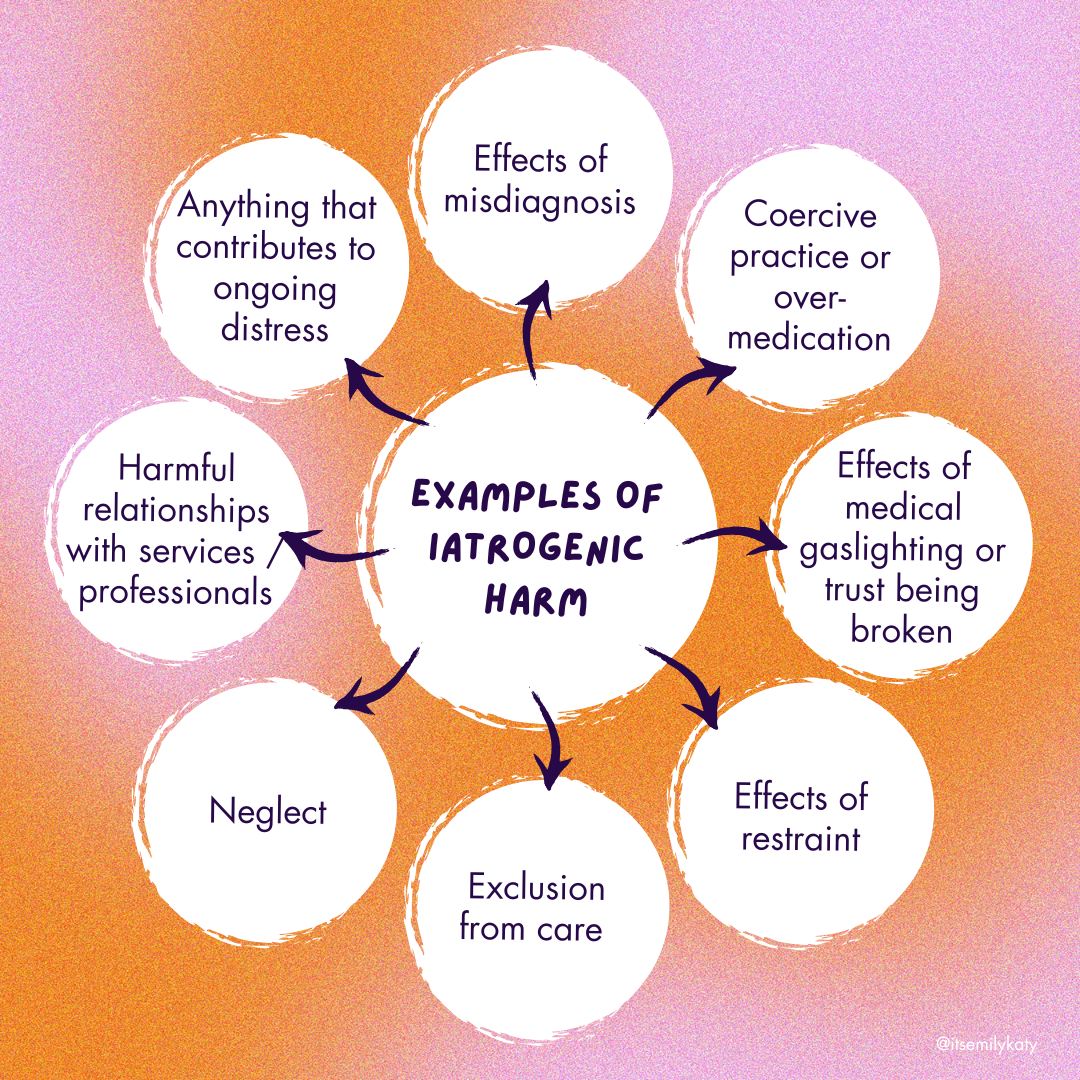
These are some examples of iatrogenic harm:
Effects of misdiagnosis
Coercive practice
Overmedication
Effects of medical gaslighting
Effects of trust being broken
Restraint
Exclusion from care
Neglect
Harmful relationships with services/professionals
Anything that contributes to ongoing distress
Iatrogenic harm can happen at any point in somebody’s care, but these are particular times it can occur:
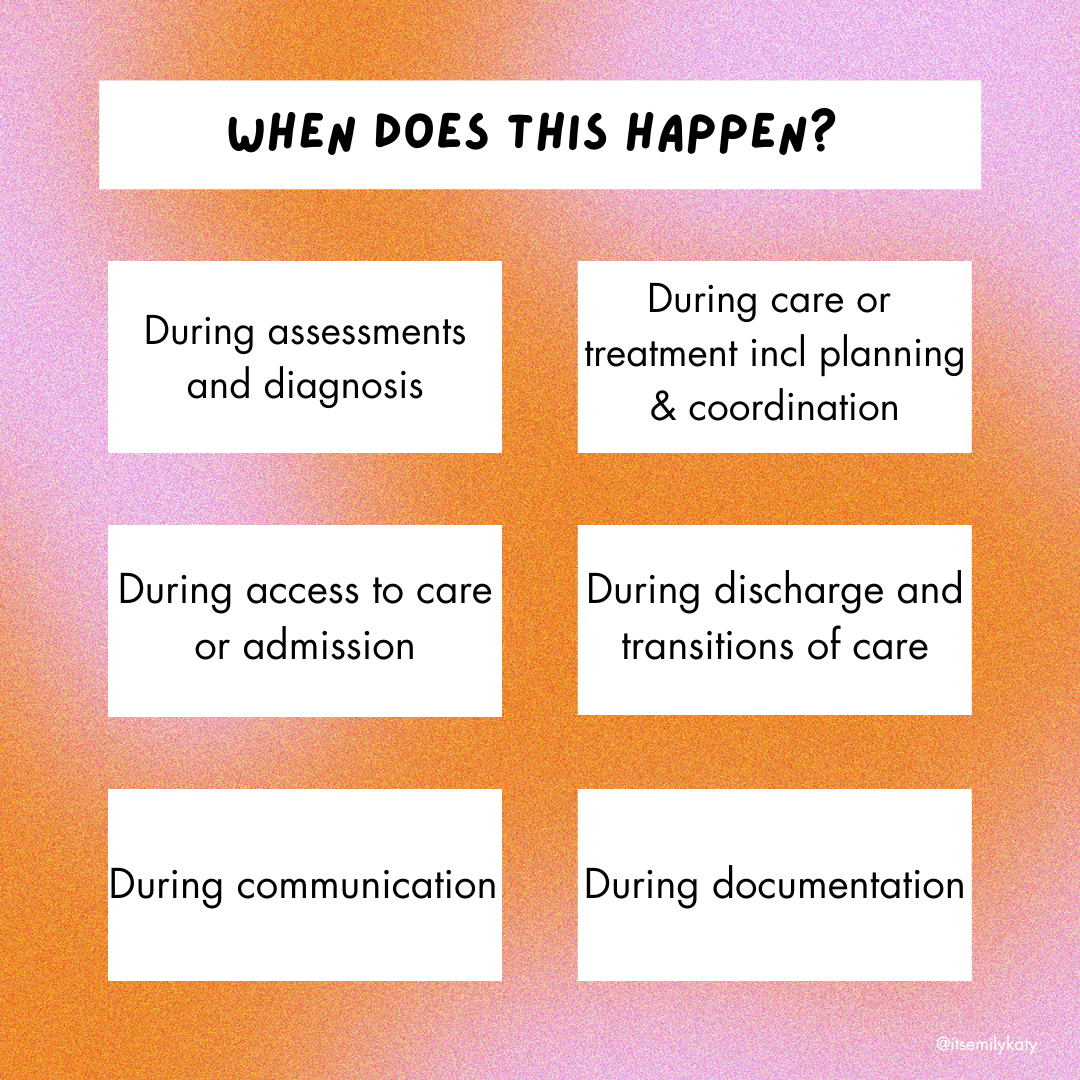
During assessments and diagnosis - assessments not completed, misdiagnosis, inadequate or inappropriate assessments
During care or treatment including planning and coordination - care/treatment unavailable or not provided, inadequate provision, dehumanising delivery of care
During access to care or admission - delayed access of care, exclusion from provision
During discharge and transitions of care - gaps in discharge planning, inappropriate discharge planning, punitive discharge (e.g. of people who self-harm)
During communication - failure to communicate, communication shaped by stereotypes or prejudice or is punitive e.g. in relation to people who self-harm or who have a personality disorder diagnosis
During documentation - failure to accurately document, biased documentation
There are specific groups of people who recurrently appear subject to harm and they include:
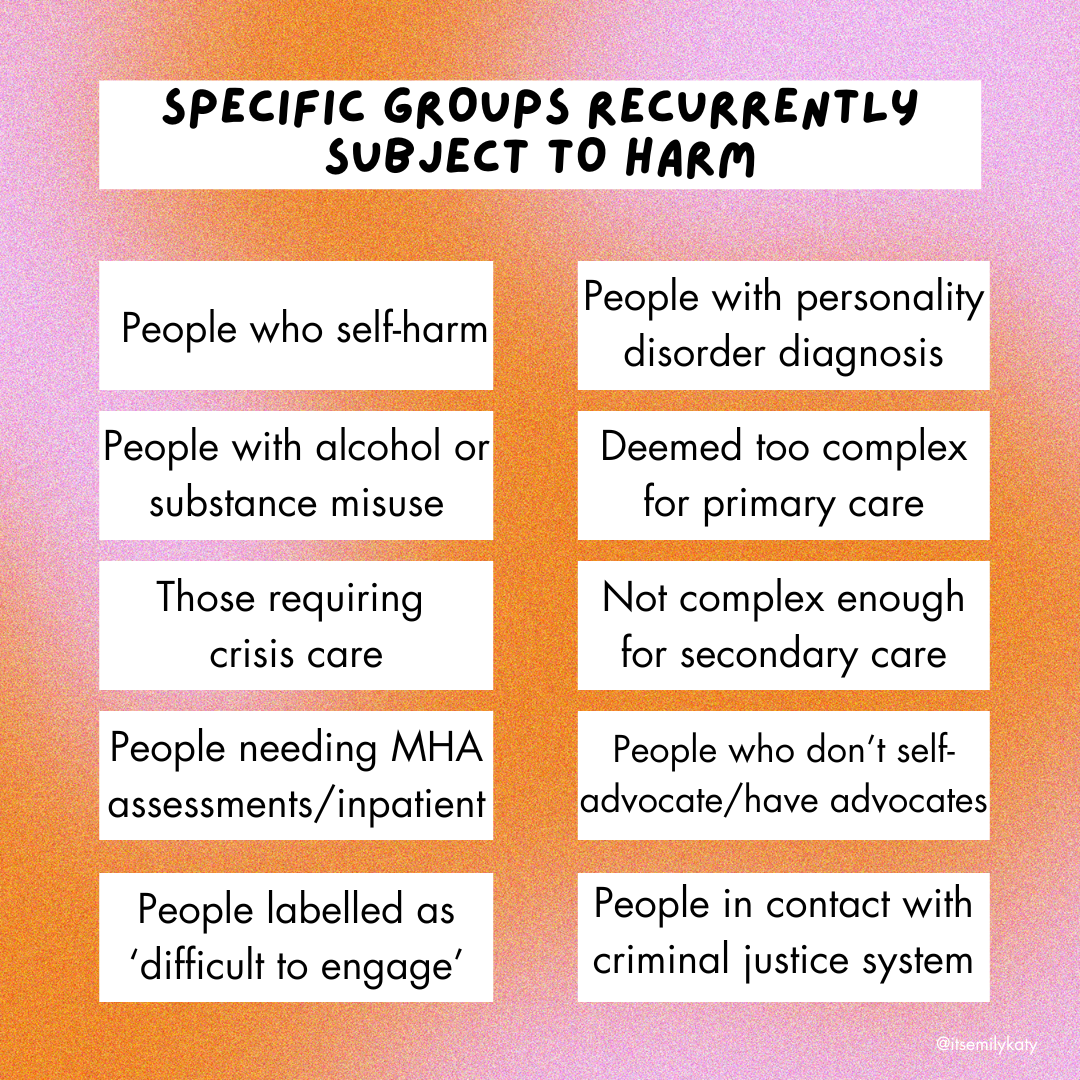
People who self-harm
People with personality disorder diagnoses
People with alcohol or substance misuse
People deemed too complex for primary care yet not complex enough for secondary care
Those requiring crisis care
Those requiring MHA assessments and inpatient treatment
People who do not self-advocate or who don’t have others to advocate on their behalf
People labelled as ‘difficult to engage’
People with co-occurring physical health conditions
People in contact with the criminal justice system
Iatrogenic harm can lead to or involve psychological harm including…
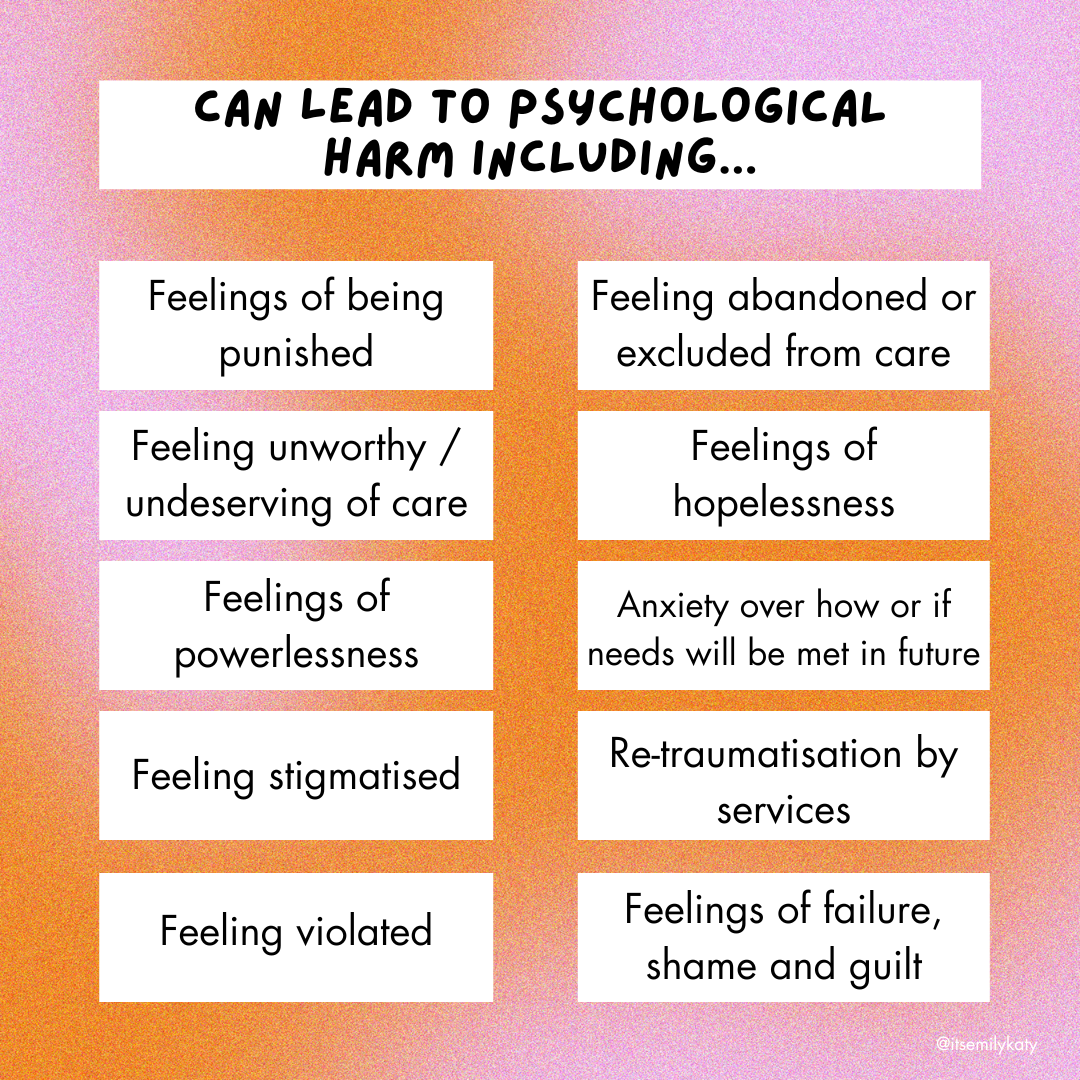
Feelings of being punished
Feeling abandoned or excluded from care
Feeling unworthy/undeserving of care
Feelings of hopelessness
Feelings of powerlessness
Anxiety over how or if needs will be met in the future
Feeling stigmatised
Re-traumatisation by services
Feeling violated
Feelings of failure, shame and guilt
Research suggests that rather than being a single incident causing harm, an individual with mental health needs may experience a series of institutional provisions/processes that are neglectful and/or abusive over the duration of months and years. In other words, iatrogenic harm isn’t generally ONE specific incident or event, but rather repeated over time.
Research also suggests that “Past experiences of mental healthcare which have been perceived as harmful can present significant barriers to accessing treatment again. A more restorative approach, founded in shared responsibility and compassionate relationships, can help minimise harm and create a more healing system.” (Downs, 2025).
An example of iatrogenic harm: In a lived experience narrative for an academic journal, Wren Aves described that “it is humiliating to survive a suicide attempt when you really did not want to. To then be confronted with ‘clearly you didn't try very hard because you were looking for attention not death’ simply pours salt on the wound. It is excruciating. As is somehow managing to make it through a suicidal crisis without attempting suicide, to be met with ‘so you weren't ever at risk then’. This places many of us in terrible positions whereby to ‘prove’ we are telling the truth, to ‘prove’ we require and are worthy of care, we have to do everything possible to end our lives” (Aves, 2023).
Iatrogenic harm is very, very real and very, very painful for those of us who experience it.
Something else I wrote this week was this:
Sometimes the deepest wounds aren’t left by mental illness itself. They’re left by the systems and people that were supposed to help us.
Professionals love to talk about co-production and ‘no decision about us without us’ when it suits them, but when it doesn’t, decisions are made that have the power to change the trajectory of someone’s life, journey and recovery.
Professionals will never understand the power imbalance. And how recovery from illness suddenly turns in to recovery from being under services, from trust and promises being broken, from feeling helpless.
Professionals don’t get to see the impact of their decisions. They go home at the end of their shift, having made a hundred decisions that day, unaware of the impact that one single decision has had on someone’s entire world.
When your voice hasn’t been heard, when your life has been something to toy with, when promises and trust have been broken - there is grief, shame, fear, mistrust, anger and helplessness in that. Feelings that don’t just disappear, but which linger, affecting every future interaction with professionals and every part of your self-worth.
Moving forward, professionals have a responsibility to consider the harm they may be causing by their decisions, and services have the responsibility to minimise or eradicate iatrogenic harm.
References
Aves, W. (2023). Escaping iatrogenic harm: A journey into mental health service avoidance. Journal of Psychiatric and Mental Health Nursing, 31(4), 668-673. https://doi.org/10.1111/jpm.13020
Downs, J. (2024). Whose trauma is it anyway? Creating more equitable mental healthcare in a system that harms. British Journal of Psychiatry, 49(4), 265-268. https://doi.org/10.1192/bjb.2024.103
Downs, J. (2026). Conceptualising trauma in eating disorders: a reflexive commentary on the role of neglect, iatrogenic harm, and epistemic injury. Journal of Eating Disorders, 14. https://doi.org/10.1186/s40337-026-01610-0
Edwards et al. (2025). Institutional Abuse, Neglect and Harm in UK Community Mental Health Services: A Scoping Review of the Peer‐Reviewed Evidence. Health Expectations, 28(5). https://doi.org/10.1111/hex.70403
Parry et al. (2016). Iatrogenic harm from psychological therapies - time to move on. The British Journal of Psychiatry, 208, 210-212. https://doi.org/10.1192/bjp.bp.115.163618
Stevens, P. (2026). Iatrogenic harm from restrictive interventions in mental healthcare: a human rights perspective. Mental Health Practice, 29(3). https://doi.org/10.7748/mhp.2026.e1772

GIRL UNMASKED (The Sunday Times Bestseller) is available to order from Amazon and all major bookstores as a hardback, paperback, audiobook and ebook. linktr.ee/itsemilykaty
If you would like to support my blog on a one-off or monthly basis, you can here: https://buymeacoffee.com/itsemilykaty